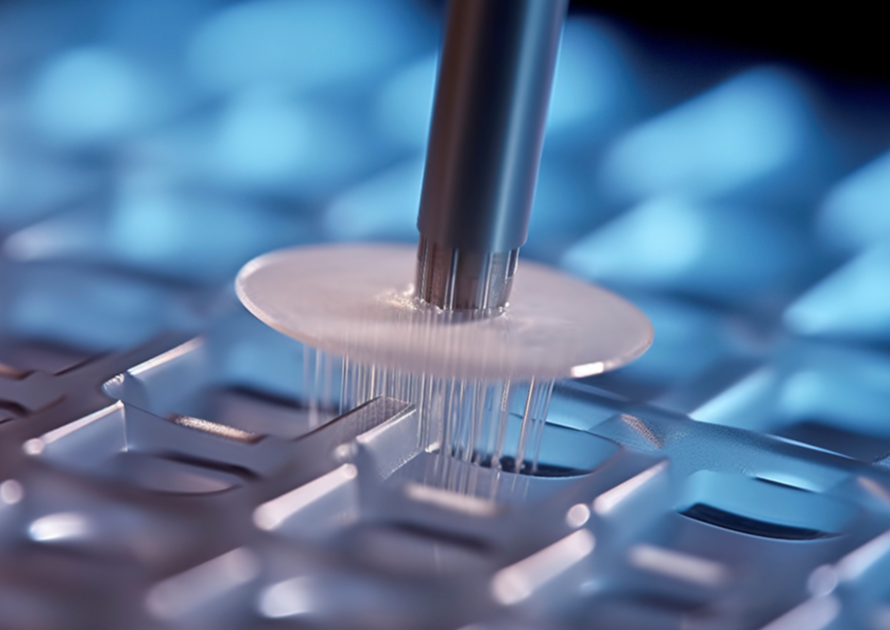
Globally, there are an estimated 285 million blind or visually impaired people. In the Western world, age-related macular degeneration is the primary cause of blindness in older adults. However, Eric Tremblay of EPFL in Switzerland unveiled a new telescopic contact lens prototype this week at the AAAS Annual Meeting in San Jose, California. This is the first of its kind, offering hope for a stronger, better vision. In addition, the optometrist introduces complimentary smart glasses that can distinguish between blinks and winks, enabling contact lens users to alternate between normal and enlarged vision.
Envision a future where a single wink can bring into focus the details that have eluded you. This isn’t some far-off idea from a sci-fi novel; it’s the potential reality brought about by telescopic contact lenses, an extraordinary advancement that is reshaping the landscape of vision care. These lenses are not just groundbreaking; they’re transformative for millions dealing with low vision. Unveiled by Eric Tremblay, the prototype incorporates a miniature telescope within the lens, magnifying the world and offering the promise of significantly improving quality of life.
What are telescopic contact lenses?
2013 saw the release of the 2.8x magnification telescopic contact lens prototype. Since then, the researchers behind the DARPA-funded project have been improving the lens membranes and creating add-ons to make the eyewear more functional and comfortable for extended periods of time. Telescopic contact lenses are a type of contact lens that uses a miniature telescope to magnify images. They are designed to help people with low vision, such as those with age-related macular degeneration (AMD), see more clearly.
How do telescopic contact lenses work?
Telescopic contact lenses work by using a series of tiny mirrors to focus light on a small area of the retina. This area of the retina is called the fovea, and it is responsible for central vision. By magnifying the image onto the fovea, telescopic contact lenses can help people with AMD see objects in the centre of their field of view more clearly.
A 1.55-mm-thick lens contains a very thin, reflective telescope that powers the contacts. The view is magnified, and objects appear larger due to tiny mirrors that reflect lightaround themd, creating the illusion of low magnification binoculars.
Currently, a rigid lens called a scleral lens is used to create telescopic contacts. This lens has a larger diameter than the usual soft contacts you may be familiar with, making it useful in certain situations, like for patients with irregularly shaped corneas. For specific applications, scleral lenses—despite their size and rigidity—are secure and comfortable. They also offer an appealing platform for technologies like optics, sensors, and electronics, which are found in telescopic contact lenses.
Several precisely cut and expertly assembled pieces of plastic, aluminium mirrors, polarising thin films, and biologically safe glues are used to create the final lenses.The scientific team has been working for the past few years to make the lenses more breathable because the eye requires a constant supply of oxygen. They are adding microscopic air channels, about 0.1 mm wide, to the lens to create oxygen permeability, which will allow oxygen to pass beneath and around the intricate and typically impermeable optical structures and reach the cornea.According to the scientists, although oxygen permeability and image quality in lenses remain research topics and challenges, advancements in mechanical and manufacturing processes are leading to better understanding and improved outcomes.
Glasses controlled by Winks:
Additionally, the researchers have created a brand-new technique for electronically switching the wearer’s view between telescopic and normal, or unmagnified, vision. For the lenses to be highly beneficial to people who do not have AMD, as they will be able to have magnification “on demand,” this switching feature is essential. Electronic glasses employing a tiny light source and a light detector to detect winks and ignore blinks made their debut at AAAS. To see normally, the wearer will wink with their left eye, and magnify with their right.
For the contact lens to be visible through the glasses, the polarization of light must be electronically chosen. In the 1x aperture of the contact lens, one type of polarisation is permitted, while in the 2.8x aperture, another.
What are the benefits of telescopic contact lenses?
Telescopic contact lenses have several potential benefits, such as improving central vision, increasing independence, and enhancing overall quality of life. These lenses can be a valuable tool for people with low vision, as they can assist in reading, watching television, and participating in activities that may have otherwise been difficult or impossible to do.
What are the challenges of telescopic contact lenses?
Although telescopic contact lenses have potential benefits, they also pose some challenges. These include limited field of view, difficulty with depth perception, and discomfort. However, researchers are currently working to overcome these challenges and develop more comfortable telescopic contact lenses that offer a wider field of view.
The future of telescopic contact lenses
Telescopic contact lenses are still in the early stages of development, but they have the potential to revolutionize vision care for people with low vision. Researchers are continuing to make progress in developing more comfortable and effective telescopic contact lenses. With continued development, telescopic contact lenses could become a widely used treatment for low vision in the years to come.
Benefits that Extend Beyond Vision Enhancement
The advantages of telescopic contact lenses extend beyond mere visual acuity. These lenses can install a renewed sense of confidence and self-assurance in individuals with low vision. The ability to engage in activities that were once hindered by vision impairment can foster a sense of empowerment and enable individuals to participate more actively in their daily lives.
A Glimpse into the Future of Vision Care
Telescopic contact lenses represent a beacon of hope for individuals with low vision. As research continues to refine this technology, we can anticipate lenses that are more comfortable, provide a wider field of view, and offer enhanced depth perception. The future of vision care is undoubtedly intertwined with telescopic contact lenses, holding the promise of a world where visual impairment no longer hinders the pursuit of a fulfilling life.
Conclusion
Telescopic contact lenses are a promising new technology that has the potential to improve the lives of people with low vision. Researchers are continuing to make progress in developing more comfortable and effective telescopic contact lenses. With continued development, telescopic contact lenses could become a widely used treatment for low vision in the years to come.
References:
- Bioengineer (2015, February 15). Telescopic contact lenses. https://bioengineer.org/telescopic-contact-lenses/
- Telescopic contact lenses let you zoom in on demand. https://www.newscientist.com/article/dn26968-telescopic-contact-lenses-let-you-zoom-in-on-demand/
- High-Tech Contact Lenses That Go Beyond Correcting Vision (2020, February 5). https://www.aao.org/eye-health/tips-prevention/smart-contact-lens-tech-beyond-vision-correction
- Telescopic Contact Lens Could Improve Eyesight for the Visually Impaired. https://jacobsschool.ucsd.edu/news/release/1386
- Image source: Designed by Freepik, www.freepik.com